Showing posts with label World War II. Show all posts

July 20, 2010

The 20 July Plot

On July 20, 1944 a group of German military leaders launched a failed attempt to blow up Adolf Hitler and remove the Nazis from power.

For years, officers of the German military had been conspiring to overthrow Hitler and other assassination attempts had been made, but the 20 July plot seems to have been the most elaborate and well thought out.

The plot has inspired several books and movies, including the 2008 film Valkyrie which stars Tom Cruise as Count Claus von Stauffenberg, the man who planted the bomb intended to blow up Hitler and then returned to Berlin to help with the coup that was to follow.

The WWII Foreign Military Studies on Fold3 include some interesting information about the 20 July plot including...

A description of the plot by Otto Ernst Remer, leader of the home guard units that helped put down the coup attempt:


A description of the impact of the failed plot by Percy Ernst Schramm, professor of medieval and modern history at the University of Goettingen, formerly Major in the Reserve Corps, and officer in charge of keeping the war diary of the Wehrmacht Operations Staff:


Ludwig Kaiser's report on the events leading up to coup attempt, which he calls the Goerdeler Movement after Carl Friedrich Goerdeler who would have served as the chancellor of the new government if the plot had succeeded. Kaiser's report begins with the German government's official statements on the plot and proceeds to describe events and discussions that lead of the 20 July:


This YouTube video provides a brief overview of the events and this one includes the audio of the speech Hitler gave after the attempt on his life. You can see some pictures and learn all sorts of details from this Wikipedia page.

February 16, 2010

WWII in Italy: Flooded Airfields, Muddy Ball Turrets and Dragons

As a follow up to this post about the life of a ball turret gunner, it seems that life for those boys could get worse in the rainy season.

Here's a picture of an airfield in Italy that was flooded after some heavy rains.
Page 172; Black and White and Color Photographs of U.S. Air Force and Predecessor Agencies...

The muddy landing strips made the ball turret gunner's life even less pleasant:
Page 256; Black and White and Color Photographs of U.S. Air Force and Predecessor Agencies...

While we're in the area, he's some great nose art on a B-24 Liberator:
Page 180; Black and White and Color Photographs of U.S. Air Force and Predecessor Agencies...


The dog doesn't seem to know what to make of it.

February 4, 2010

War: Bringing People Together

"Naga Headhunters [Learn] To Cut Hair"

I don't know anything about any of the people in this picture, but when I read the caption,
"In Addition To His Other Duties, Pvt. Morris Glieberman Of New York City Was Barber For The Yank Expedition. Here, He Teaches Naga Headhunters To Cut Hair, Using Pfc. Jack Elston Of Salt Lake City, Utah As The Victim."
I couldn't help but think, "So, a Mormon, a Jew and a headhunter walk into this bar[bershop]."

January 11, 2010

Survivor of Two Atomic Bomb Blasts Dies at Age 93

On Jan 6, 2010, Tsutomu Yamaguchi died. Mr Yamaguchi had the distinction of being the only officially recognized survivor of atomic bombings at both Hiroshima and Nagasaki.

Sometime last year, while I was looking through the World War II Air Force photos collection and doing some research on those first atomic bombs, I came across Akira Iwanaga and Kuniyoshi Sato (there is a slightly shorter version republished in March of 2009 with a couple of photos here.) Parry explained that,
"In 1945, they were working in Hiroshima, where the world's first atomic bomb exploded on August 6... One hundred and forty thousand people died as a result of the explosion; by chance, Mr Yamaguchi, Mr Sato and Mr Iwanaga were spared. Stunned and injured, reeling from the horrors around them, they left the city for their home town, Nagasaki, 180 miles to the west. There, on 9th August, the second atomic bomb exploded over their heads."
These survivors' descriptions of the scenes during and after the bombings are vivid and shocking and provide a powerful reminder of just how terrible a weapon an atomic bomb is.

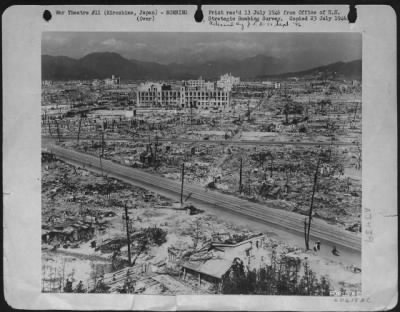
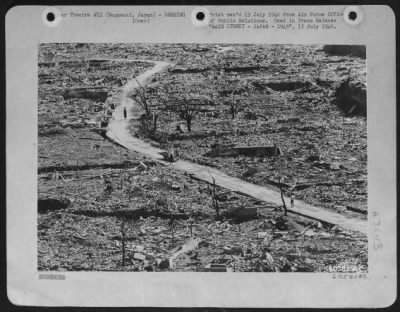
Some of the photos of the aftermath of the atomic bomb blasts at Hiroshima and Nagasaki have a similar effect:

Page 1; Black and White and Color Photographs of U.S. Air Force and Predecessor Agencies...
'View of Hiroshima taken from Red Cross hospital building about a mile from focal point of blast."

Page 1; Black and White and Color Photographs of U.S. Air Force and Predecessor Agencies...
Nagasaki: "A street through a formerly congested residential area... 1,000 ft. northeast of atom bomb burst."

Hopefully stories like Mr Yamaguchi's will be retold and remembered so that they will never be repeated.

December 7, 2009

Remembering Pearl Harbor

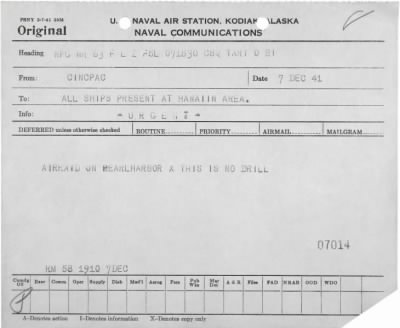
This urgent radiogram to "All ships present at Hawaiin Area" announced the December 7, 1941 attack on the US Pacific Fleet based in Pearl Harbor:
WWII Pearl Harbor attack radiogram

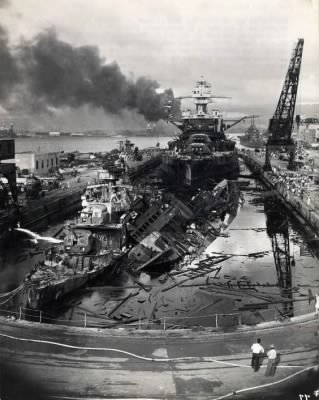
The surprise attack damaged all eight battleships anchored in the harbor and caused over 3,000 American casualties.
Pearl Harbor 13.JPG

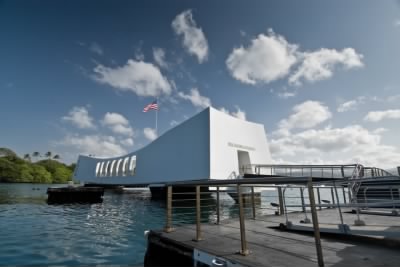
1,177 died on the USS Arizona and are remembered with a memorial that was built over the top of the still visible remains of the battleship which lies at the bottom of the harbor.
3.JPG

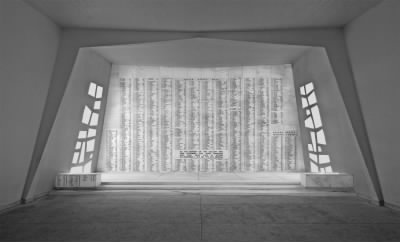
The memorial includes a wall with the names of those killed on the Arizona in 1941 and a place for those who have died since and had their remains "interred with their shipmates."
page; Pearl Harbor, USS Arizona Memorial

On Footnote, you'll find an interactive image of the memorial wall where you can learn more about those who died or if you have images or stories about someone whose name appears, you can add them.

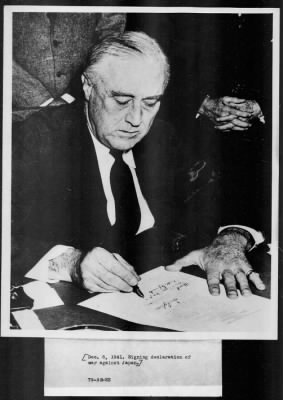
The day after the attack, President Franklin D Roosevelt delivered his famous "Day of Infamy" speech to Congress. In his speech, Roosevelt asked Congress to declare that, since the attack on Pearl Harbor, a state of war had existed between the United States and the Empire of Japan. You can hear the full six and a half minute speech on this Wikipedia page.

Within an hour of the speech, Congress passed a formal declaration of war which Roosevelt signed, bringing the United States into World War II.
Page 1; Selected Photographs of Franklin D. Roosevelt, 1913-1945


In honor of Pearl Harbor Day, Footnote is making their WWII collection free during December. You can read more on the Footnote Blog or see the World War II collection here.

November 11, 2009

NARA Asks for Input on Motion Picture File Formats

Today, on the NARAtions blog, the folks at the National Archives are asking how we would like them to make their motion picture archives available.

I'm hoping for a streaming solution and one that will make them embeddable. Be sure to give them your input.

In celebration of Veterans Day, here's a WWII news reel from NARA's collection:

October 17, 2009

Doctored Photos

Here's an interesting Time article about doctored photos starting with an example from the Brady Collection.

A while back, Blake found and interesting example of photo doctoring on Footnote.

Here's a picture of Omaha beach after the D-day invasions, scanned from a mounted card in NARA's image collection:
Page 44; Black and White and Color Photographs of U.S. Air Force and Predecessor Agencies...

The planes at the top add to the excitement, but it looks like they were added to the picture. Here's what appears to be the same picture, but without the planes flying overhead:
D-Day Omaha Beach June 1944.jpg


Update [Oct 21, 2009]: The New York Times is running a seven part series by Errol Morris exploring the manipulation of photos.

October 14, 2009

Cataloging a Stolen Heritage

As Allied forces made their way into Germany toward the close of World War II in Europe, US Zone Commanders were instructed to impound certain types of artifacts that the German Reich, Nazi Party and others had taken from individuals and institutions in Germany and countries they had occupied.

The army set up temporary collecting points for the various types of impounded items and then cataloged the collections as they tried to find out where things belonged.

At NARA, the records of these looted items are grouped as the “Ardelia Hall Collection” because Ardelia Hall, the US State Department’s Arts and Monuments Adviser worked extensively with the records from 1954 to 1961.

You can read more details about the collecting points, the process of sorting through the arifacts and the Ardelia Hall collection here.

The other day, I found some interesting things while poking around the Wiesbaden Property Cards from the Ardelia Hall Collection in Footnote's Holocaust Collection (the Ardelia Hall titles are included in a group called Holocaust Era Assets).

Most of the material at the Wiesbaden Collection point came from German holdings, like these from the Staatliche Museen in Berlin:


But, some of the works cataloged at Wiesbaden we presumed taken from other countries, like this work by Taesler which may have been from Russia :

Other works came from individuals, like this scene painted by Kobell which may have belonged to Siegfried Reiss:

In many cases, there was no way of knowing where the items came from and for some, the collectors had only a general idea of where the item belonged, as with this portrait by Poeckh, presumed to have a "Jewish Owner":

I don't know what they did with all the items they could not identify, but I came across several works with an note like the following:
"By order of Mr. Theodore A Heinrich Cult. Aff. Adviser Propert. Div. OEA HICOG. This object has been destroyed as being of no historical and arthistorical value."


Is the lack of historical or "arthistorical" value reason enough to destroy someone else's painting?

It made me wonder what Mr Theodore A Heinrich thought about as he ordered the destruction of these stolen pieces of the cultural heritage of nations and people who had suffered so many other tragedies at the hand of the Nazis. Sounds like a pretty tough job. There is more information about Mr Heinrich here.

This picture in particular, with the note, "Destroyed by order of the Director," struck me:

Who was she? Did she have a family? Did a concentration camp administrator order her destruction? Did Allied commanders order a bombing raid that destroyed her home? Was this the only picture there was of her?

June 5, 2009

Remembering D-Day

Tomorrow, June 6th, is the 65th anniversary of the D-Day invasion of Normandy, so today I poked around Footnote to see what kinds of related things I could find.

I didn't get too far because after looking at photos from the WWII Air Force Photos...

Page 28; Black and White and Color Photographs of U.S. Air Force and Predecessor Agencies...
Delivering "waterproofed vehicles"

Downed P-47 on a Normandy Beach
A downed P-47 on a beach in Normandy

...I found some documents in the World War II Foreign Military Studies collection that were so interesting I got stuck reading them. The Foreign Military Studies include reports and other documents from German sources that provide a unique perspective.

Here's a translation of a page from "telephone diary of the 352 infantry division." It begins with early reports of paratroopers and personnel carrying gliders and then continues through the invasion by sea.

Page 45; Guide to Foreign Military Studies, 1945-54
If you click through to the image you can get to the other pages
of the diary using the filmstrip at the bottom of the viewer

And here's page one of a translation of Generalleutnant Wilhelm Richter's account of "The Battle of the 716th Infantry Division in Normandy." He describes German preparations, the weather and the events of the initial invasion and the days following.

Page 2; Guide to Foreign Military Studies, 1945-54
Again, you can use the filmstrip to see the rest of the report.

You'll find these images and more about D-Day on this Footnote Page. The page is open for contributions, so if you have something you'd like to share about D-Day, you can add to the page too.